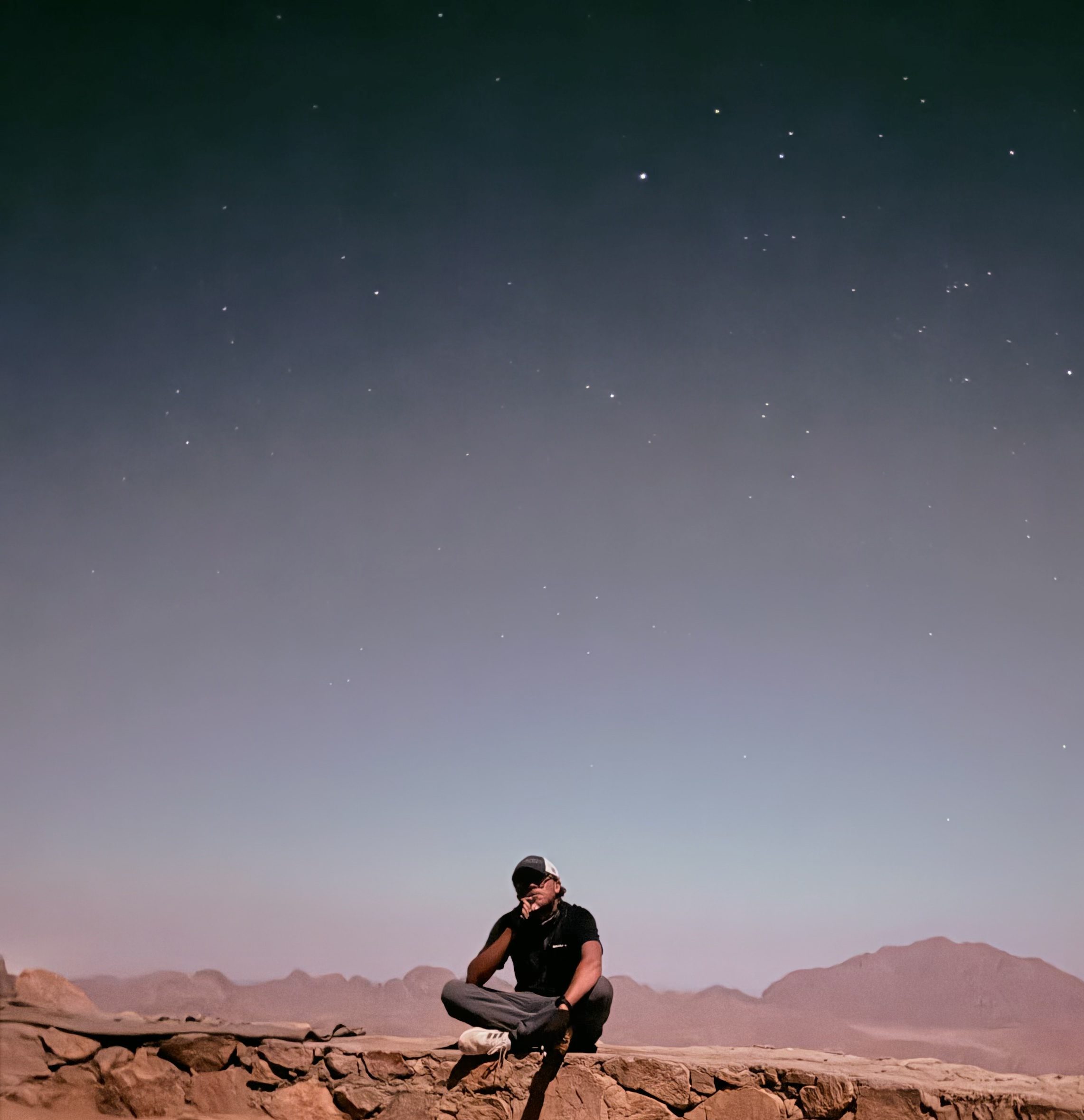
Three crossings from Ras Sudr: Wadi Tal on foot, Serabit el-Khadim on foot, Wadi Tal on two wheels.
A hundred kilometres northwest of Ras Sudr, toward Abu Zenima, the peninsula tightens into wadis and plateaus that have outlived every empire that tried to name them. In three movements we went there.
The first two crossings were made by car as far as the ground would allow a vehicle, then on foot into the locations themselves — Wadi Tal, then Serabit el-Khadim where Pharaohs resided. The third was different. We loaded the mountain bikes into my friend Zak’s classy Benz and drove back toward Wadi Tal, the comfort of the saloon ending exactly where the doctrine began.
The sequence was not leisure. It was doctrine. Walk the desert before you ask a chain to argue with it.
I. Wadi Tal — the first silence
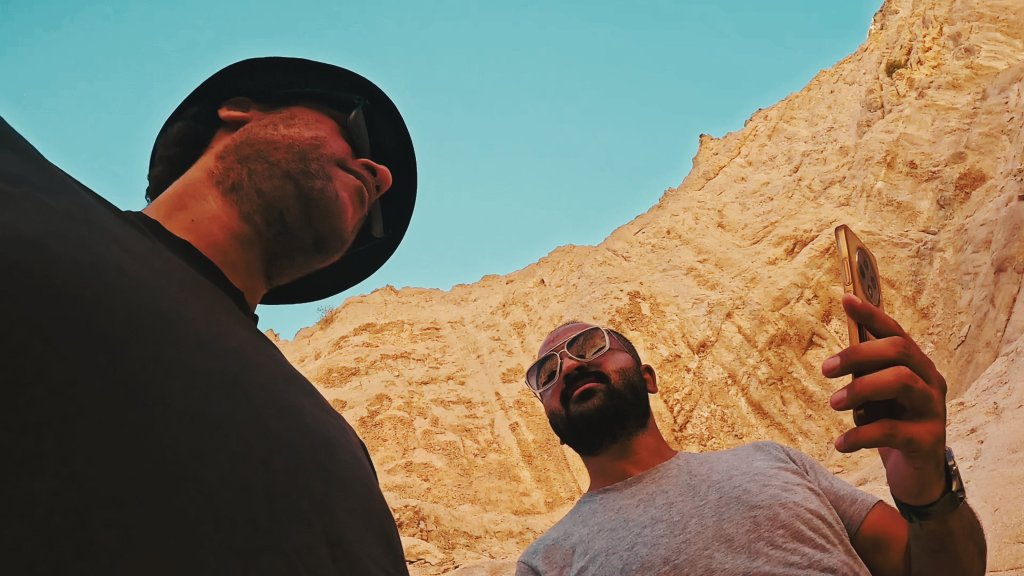
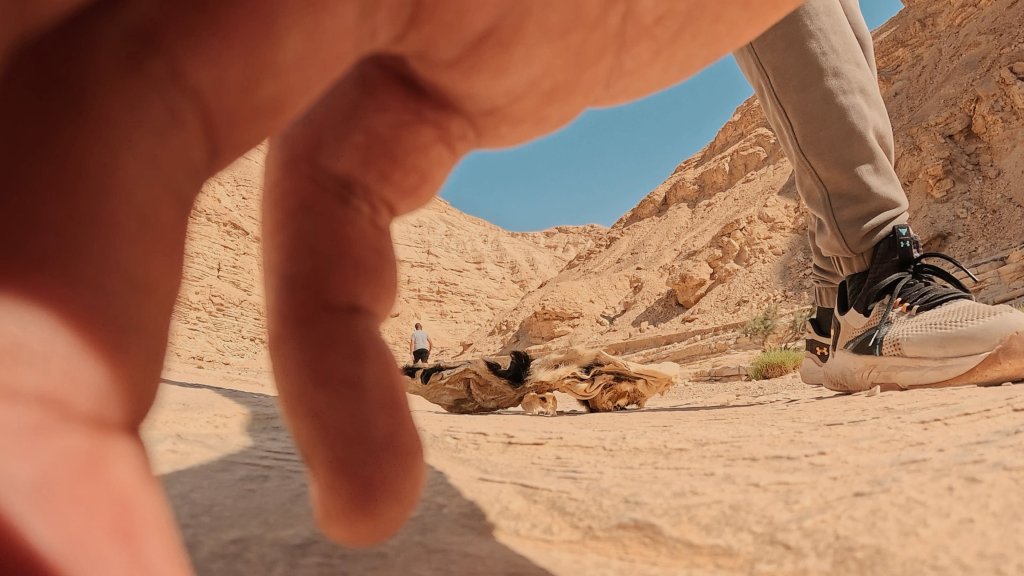
The first crossing was a hike into Wadi Tal.
A wadi is not a trail. It is a sentence the mountain wrote in flood and then abandoned to the wind. The floor is pale rubble and compacted sand. The walls are cut as if a blade had been drawn through the rock and left standing. There is no shade that lasts. There is no soundtrack except the sound of your own blood insisting on itself.
We walked it because the body must be introduced to a place before the bicycle is allowed to argue with it. Sinai has no patience for riders who treat the desert as a gym with better lighting. The rock remembers who hurried. The heat keeps the minutes.
In Wadi Tal the spirituality is not imported. It is geological. Layer upon layer of stone, older than scripture, stacked like a ledger. You do not pray at it so much as you are forced to stop performing. Conversation thins. Water becomes a sacrament you measure in swallows. The keffiyeh is not costume; it is a treaty with the sun.
We came out of that first day smaller and cleaner. That was the point.
II. Serabit el-Khadim — the mountain that invented writing
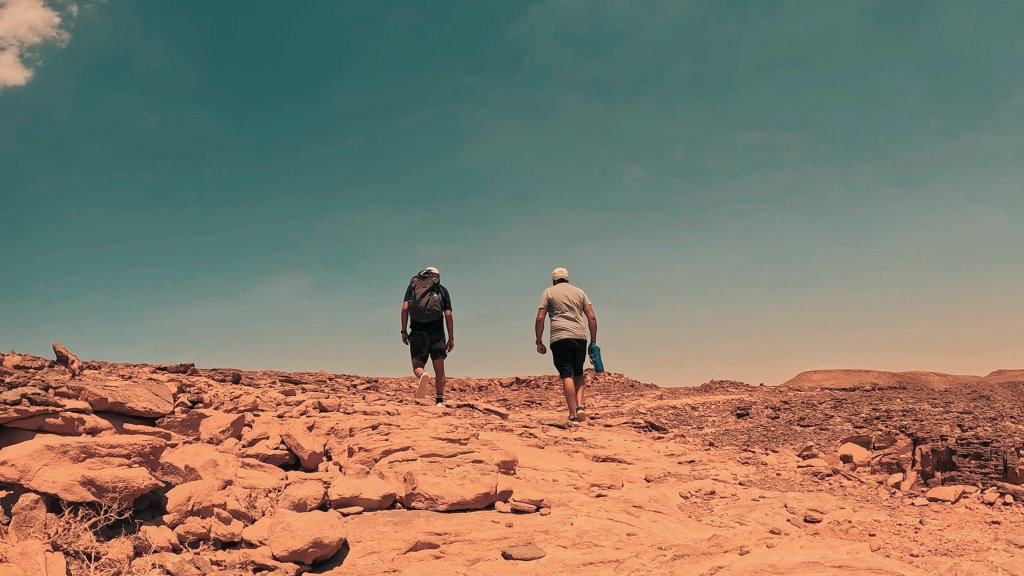
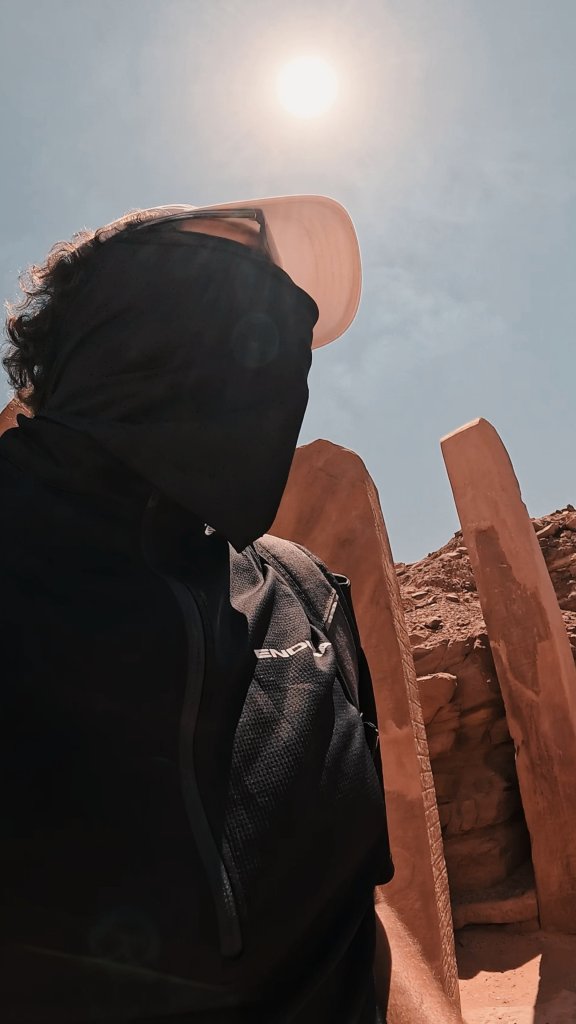
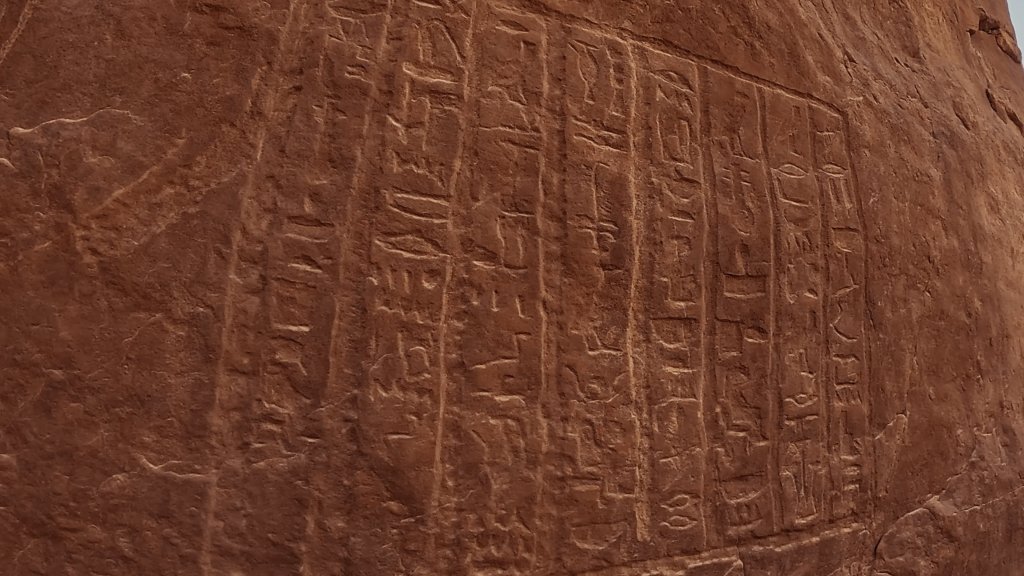
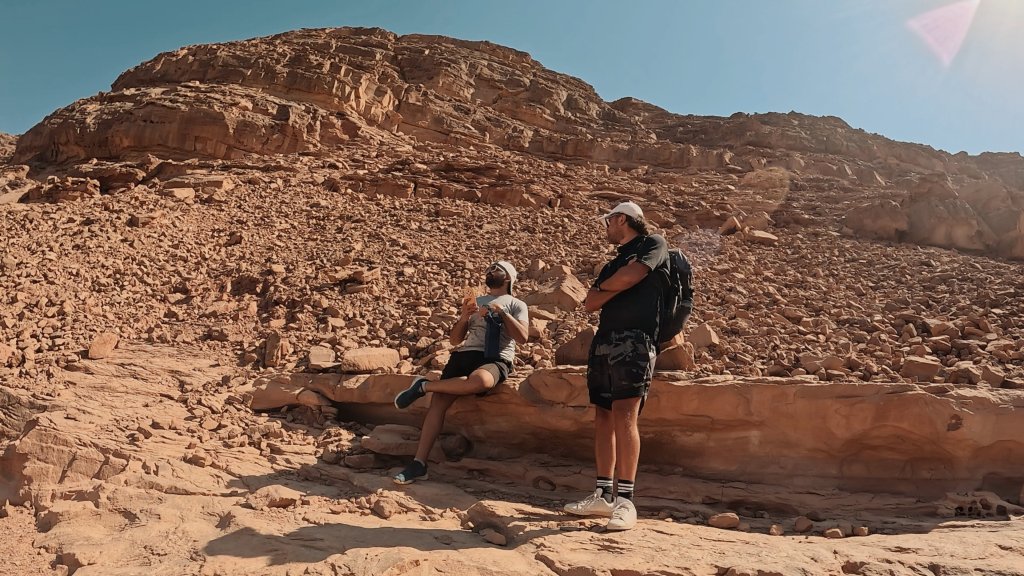
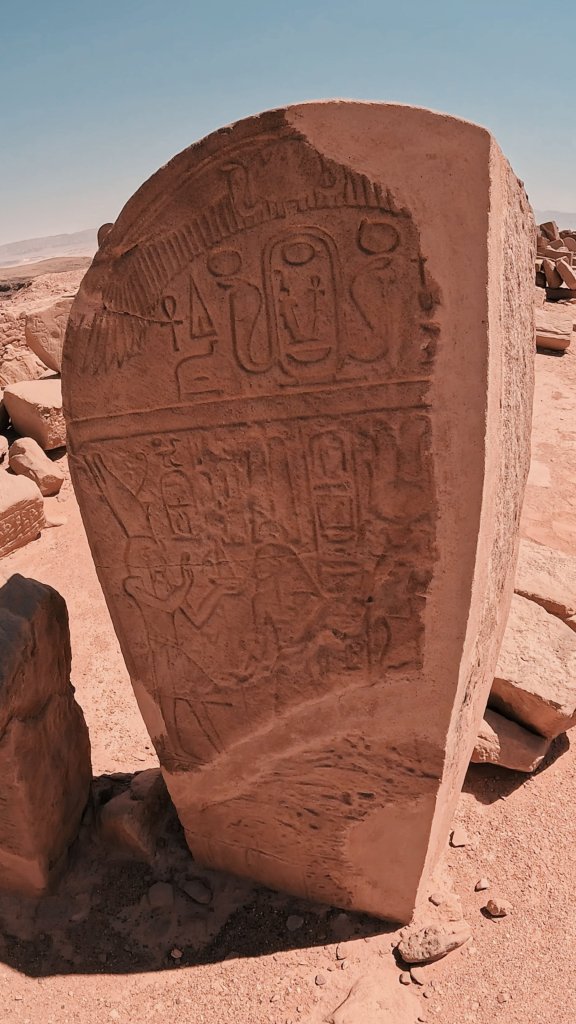
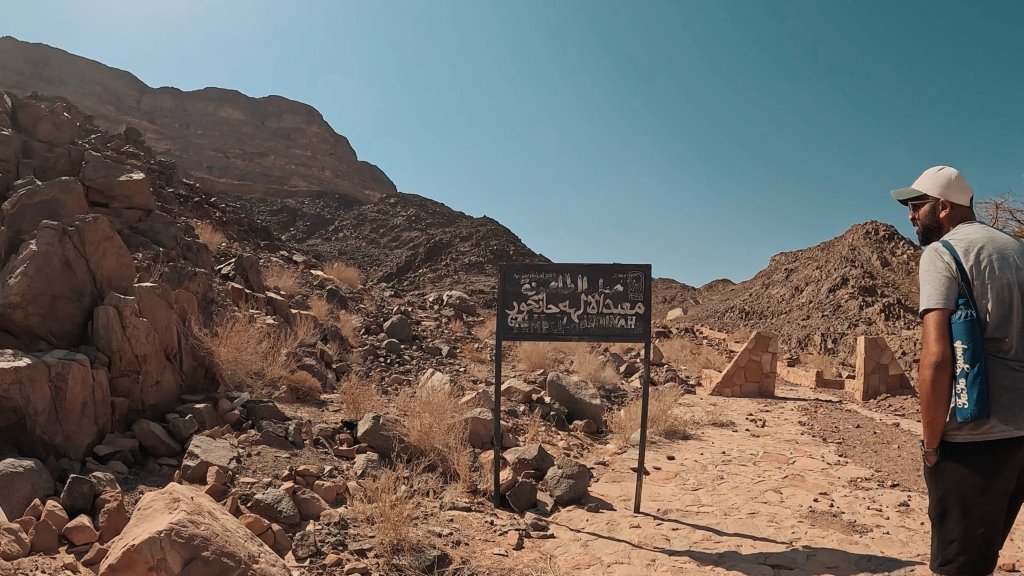
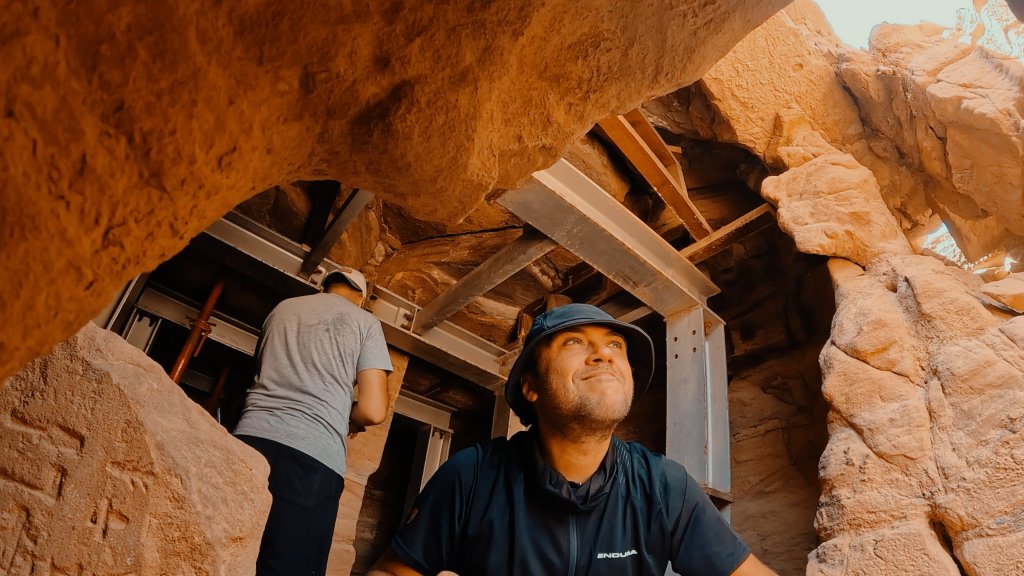
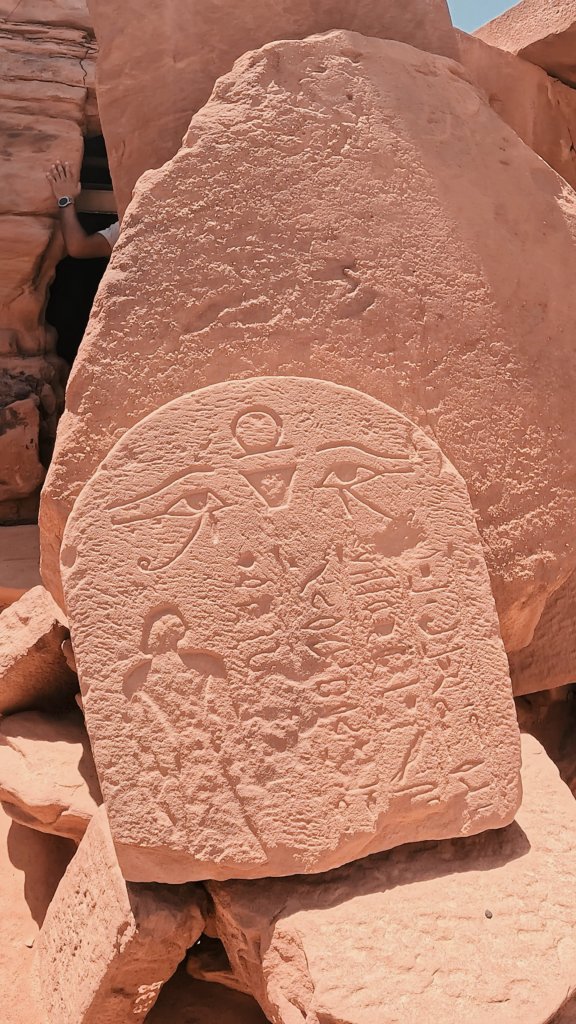
The second crossing went farther into the same country: Serabit el-Khadim, east of Abu Zenima, high on a plateau the pharaohs used as a mine and a temple.
This is not a viewpoint. This is one of the few places on earth where stone, labour, goddess and alphabet occupy the same ridge.
For more than a thousand years Egyptian expeditions tore turquoise and copper from these hills. They built, on the height, a temple to Hathor — the Turquoise Lady, patron of miners, of desert crossings, of the dangerous work that happens far from the Nile. The ruins still hold their columns. The name itself, Serabit el-Khadim, “the columns of the slave,” does not flatter anyone. It tells you what the mountain cost.
On the same slopes, in the early second millennium BCE, Semitic workers cut signs into the rock that are among the earliest ancestors of every alphabet that followed — including the one in which this sentence is written. The first letters were not born in a library. They were scratched beside a mine, under a goddess, in a heat that does not negotiate.
To hike that approach is to climb into an argument that has already been won by the stone. The sandstone is gold and rust. The wind comes across the plateau without courtesy. You arrive at the temple not as a tourist collecting a ruin but as a late worker reporting to a site that closed millennia ago and never quite shut.
Stand there long enough and the aggression of the place becomes clear. Empires sent men here to extract colour from the mountain. The mountain kept the names. Hathor kept the threshold. The alphabet left. We are the afterthought.
We descended changed. The legs knew it. The mind took longer.
III. Return on the bike — Wadi Tal, second claim
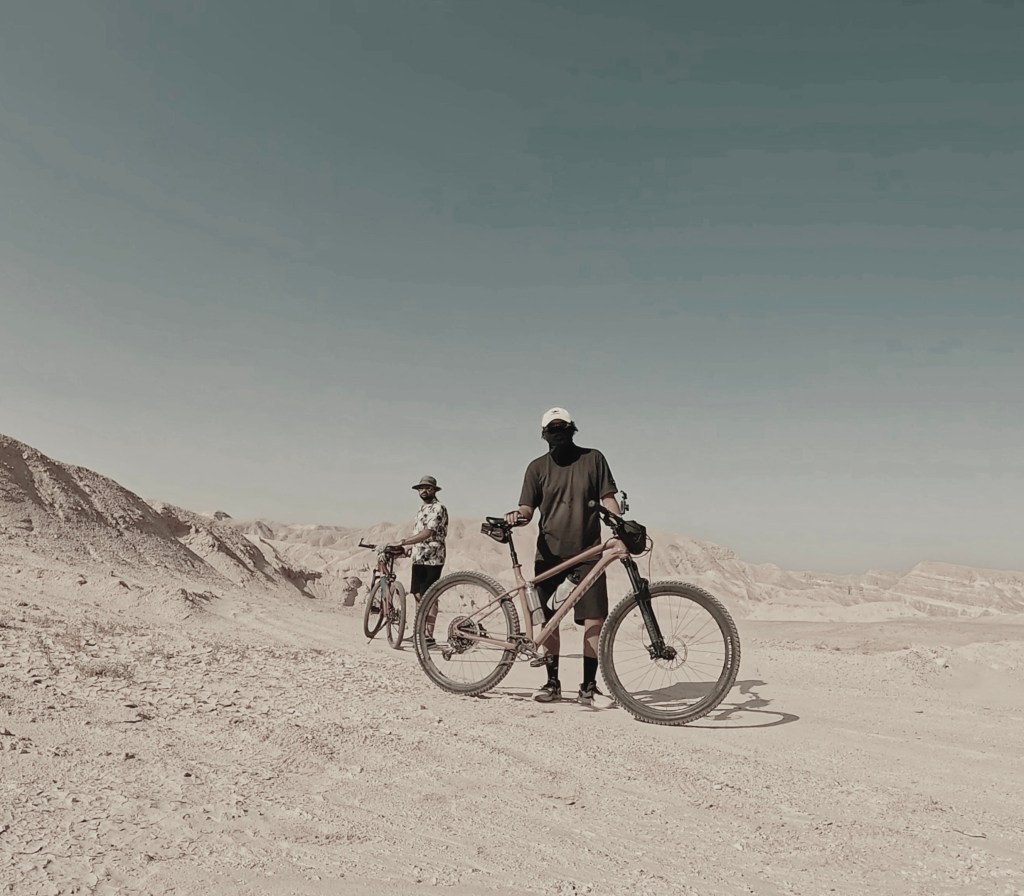
The third crossing was the necessary violence.
We took the mountain bikes and went back to Wadi Tal.
On foot the wadi had been liturgy. On two wheels it became a demand. The same pale floor that had received our steps now took the tyre and gave almost nothing back. Sand steals cadence. Loose stone punishes a lazy line. The heat does not care that you have a Garmin on your wrist and a number on the computer — eleven kilometres an hour, thirteen-point-nine, whatever the watch consents to display. Speed here is not glory. It is evidence that you are still moving.
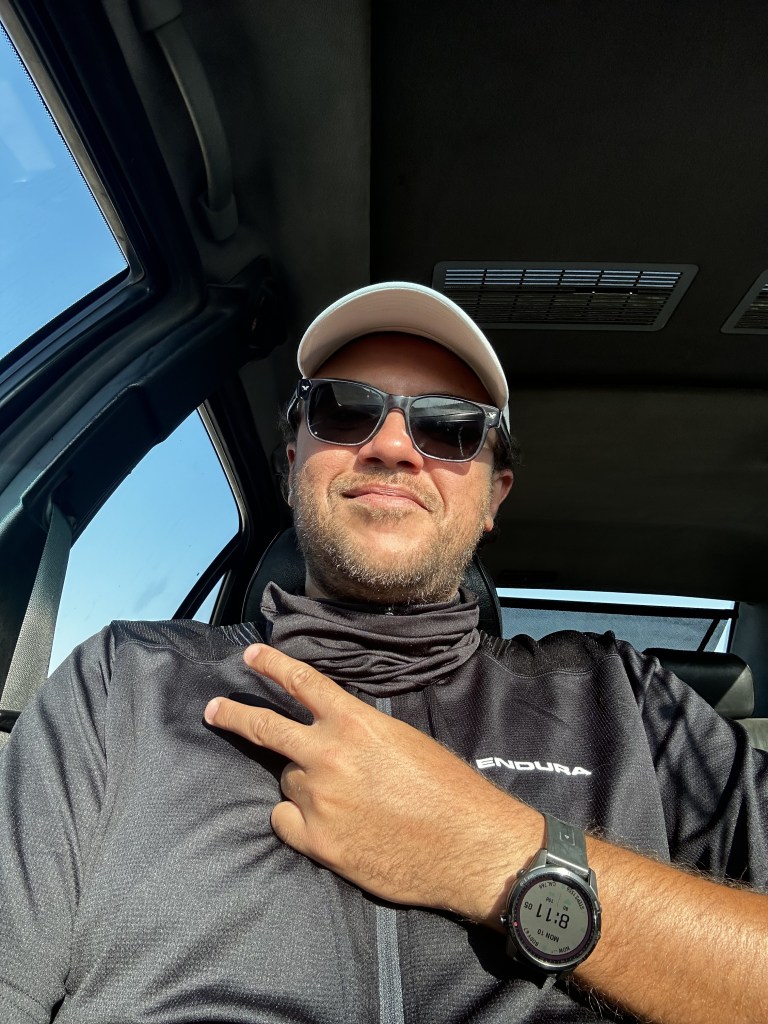
We rode out from the edge of settlement: low ochre buildings, a ribbon of asphalt giving way to gravel, power lines stitching a sky that had no clouds left in it. Faces wrapped. Gloves on. Bottles caged. The copper frame against the hill. My friend Zak’s red Galaxy standing in the shade of a cliff as if the cliff had agreed to keep it for an hour.
Then the open country.
Two riders on a pale track with the ranges stacked behind them like a second, harder horizon. No trees to break the light. No gallery. No rescue that arrives on time. This is the Sinai the road-cyclist never meets and the resort never advertises: a place that will take your water, your breath and your certainty, and will not refund any of them.
We stopped where the rock offered a ledge and sat. Bikes laid down like tools after labour. The cliff behind us was white and carved by water that is no longer there. That is the spiritual fact of a wadi. The flood did the architecture. We are only permitted to pass through the rooms it left.
Riding it does not dominate the land. Anyone who says otherwise has not been there long enough. What the bike does is concentrate the will. Pedal stroke against gradient. Line choice against rubble. The mask against dust. The watch against the lie that you are fine. Formality is useful here. You address the mountain in complete sentences or you start making mistakes.
The aggression is not against the companion beside you. It is against the part of the self that wants the café, the shade, the shorter loop, the story without the climb. Sinai does not host that person. Sinai evicts him.
When we rolled the last metres back toward the road, the body had been told the truth: the hike had introduced the ground; the temple had given it history; the bike had made the body pay in the only currency the desert accepts — effort that cannot be posted in advance.
What the three trips are for
These were not three outings. They were one education in three keys.
Walk Wadi Tal so the silence can work on you before the machine arrives.
Walk Serabit el-Khadim so you remember that this peninsula was already sacred, industrial and literate while most of the world was still guessing at signs.
Ride Wadi Tal so the lesson leaves the mind and enters the legs.
From Ras Sudr the distance is modest on a map and severe on the ground. Hundred kilometres northwest is enough to leave the kite lagoons and the weekend traffic and enter a country that still belongs to rock, wind, and the people who have read both for longer than we have owned carbon and GPS.
Respect follows from that. Water is finite. Shade is earned. Bedouin ground is not a backdrop. The temple is not a playground. The wadi is not a content set. If you come here to extract a photograph and leave no discipline behind, you have understood nothing and the mountain will not correct you kindly.
A note to the rider who thinks he is ready
Bring wide tyres. Bring more water than pride. Cover the face. Start earlier than comfort suggests. Learn the hike before you claim the descent. Do not confuse a speed overlay with mastery. Ten to fifteen kilometres an hour in this heat, on this surface, with this sun, is not slow. It is honest.
If you want groomed singletrack and a café at the trailhead, stay where those things exist. They are legitimate. They are not this.
If you want a peninsula that will strip the performance off you and leave the rider standing in the wreckage, come to South Sinai. Base yourself in Ras Sudr. Point the bike toward Abu Zenima. Take Wadi Tal first on foot so you know what you are asking of the frame. Climb to Hathor’s ridge so you know what kind of ground you are on. Then go back with the mountain bike and do not ask the desert to be gentle.
It will not be.
That is why we came.
Ahmed K.
CYCLOPATH
cyclopath.store
 Ahmed K.